
Homeowners Insurance Is Not a Maintenance Plan
Homeowners insurance is there for covered losses, but it may not rescue you financially after you've allowed a small, known maintenance problem to develop into major damage.
There’s a small water stain on the ceiling. It isn’t dripping. The ceiling isn’t falling down. You’ve been meaning to find out where it’s coming from, but there’s always something else to do. Maybe you cover it with a little paint so it no longer shows.
When the stain reappears, you add a little more paint.
Months later, the stain has escaped the paint. Water has been getting into the ceiling or wall. Insulation is wet. Drywall is damaged. Mold may be growing where you can’t see it.
What might have been a relatively minor repair has become a much bigger problem.
And then comes another unpleasant surprise: Your homeowners insurance may not cover all of the damage.
Sudden Damage and a Long-Term Leak Are Not the Same Thing
One important factor in a water damage insurance claim is how the damage happened.
A pipe that suddenly bursts and floods your home is very different from a plumbing fixture that has been leaking for months. Homeowners insurance generally covers sudden and accidental water damage, depending on the policy. Damage resulting from ongoing maintenance problems, deterioration or continuous leakage may be excluded.
The Insurance Information Institute notes that poor home maintenance is generally the homeowner’s responsibility. Allstate similarly explains that damage caused by unresolved maintenance issues, such as continuous plumbing leakage, generally is not covered.
Discovering a small problem and deciding to deal with it “later” can become an expensive decision.
It Was Just a Damaged Showerhead Mount
Consider a damaged showerhead mount.
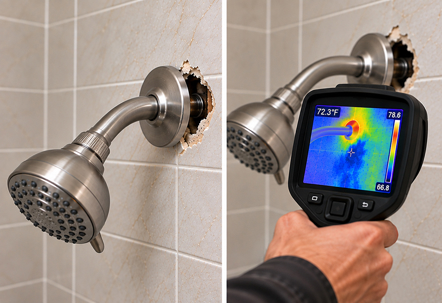
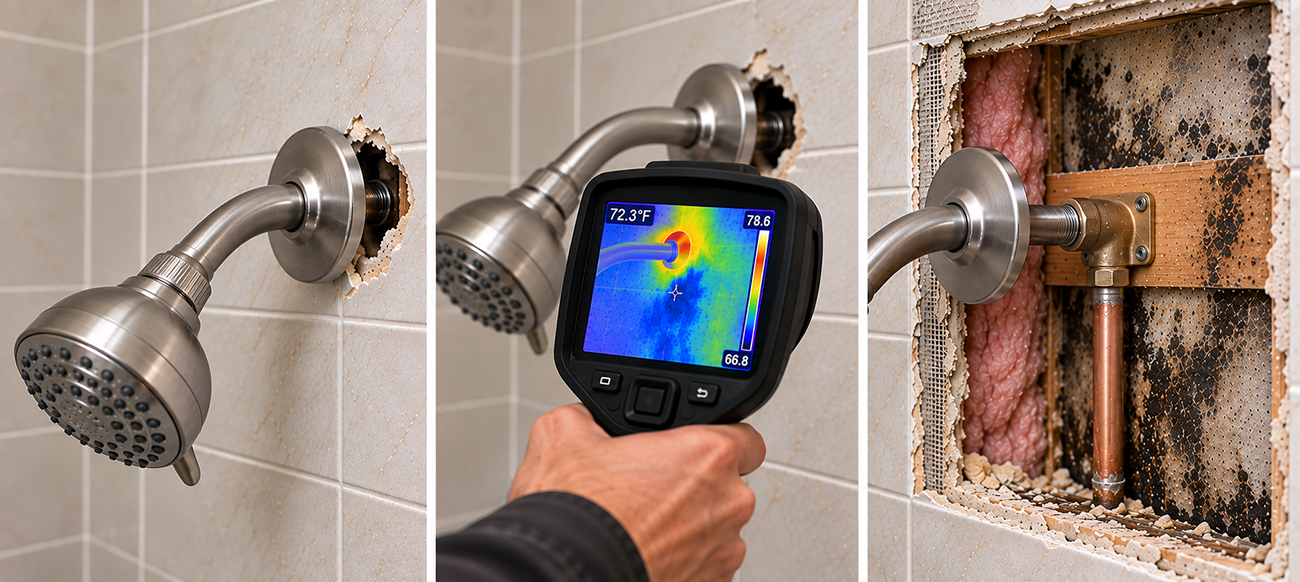
After repeated adjustments, the showerhead mount pulls away from the wall, damaging the surrounding tile and leaving an opening around the fixture.
The shower still works. Although the damage is clearly visible, the homeowner figures he'll get around to fixing it eventually.
So everyone keeps using the shower.
With every shower, a little more water finds its way through the opening and behind the wall.
Nothing looks particularly alarming from the outside. But behind the tile, moisture is accumulating in a place no one can see.
Eventually, the occupants begin experiencing sinus irritation and headaches that they attribute to seasonal allergies. When the problem is finally investigated, thermal imaging identifies a suspicious temperature anomaly below the shower fixture. Further investigation reveals extensive moisture damage and dark mold growth hidden inside the wall.
Then comes the insurance claim.
An adjuster determines that the damage resulted from repeated water intrusion through a visible opening that had been left unrepaired.
Instead of a sudden and accidental water loss, the damage developed over time from a known condition that could have been addressed much earlier.
Depending on the policy, that distinction can mean the difference between a covered loss and a denied claim.
The homeowner could be left paying out of pocket for mold remediation, removal of damaged materials, plumbing repairs and reconstruction of the shower wall.
All because of a repair that kept getting put off until later.
It Has Happened Here in Rhode Island
A 2026 federal court case involving a Bristol, Rhode Island home illustrates how prolonged leakage can affect insurance coverage.
A failed hot-water shutoff in a second-floor bathroom allowed water to run through an unoccupied home for an extended period, causing severe damage.
The insurance company denied the claim based on policy language excluding water leakage that occurs or develops over time. The homeowners challenged the decision, but the U.S. District Court for the District of Rhode Island ruled in favor of the insurance company.
The circumstances were unusual, but the lesson applies to much smaller problems:
How long water has been leaking can matter.
Mold Can Complicate the Claim
Mold coverage varies by policy and circumstances. Mold resulting directly from a covered event, such as a sudden burst pipe, may be treated differently from mold caused by a long-term moisture or maintenance problem.
And mold can develop quickly. The Insurance Information Institute advises that if water-damaged materials cannot be dried within 24 to 48 hours, mold growth should be assumed.
That's why stopping the source of water and properly drying affected materials quickly matters.
Don't Ignore the Little Things
Watch for:
- Water stains on ceilings or walls.
- Loose or damaged shower and tub fixtures.
- Cracked tile, deteriorating grout or caulk, or openings where water can enter.
- Dripping faucets, toilets, supply lines or plumbing fixtures.
- Musty odors.
- Peeling or bubbling paint.
- Soft, warped or discolored flooring.
- Water around windows or doors after rain.
- Recurring basement moisture.
- Dampness beneath sinks, around toilets or behind appliances.
- Unexpected increases in water usage.
If you find a problem, don't simply wait to see whether it gets worse. Stop the source of the water if possible and determine how far the moisture has traveled.
A wall, ceiling or floor can appear dry while moisture remains hidden underneath or behind it. Professional moisture detection and drying equipment can help locate hidden moisture before the damage becomes worse.
Fix the Little Problem While It's Still a Little Problem
Tightening a loose fixture, repairing damaged tile or caulk, investigating a ceiling stain or fixing a small leak can be easy to postpone.
But a relatively inexpensive repair can become a repair costing thousands when water is allowed to keep entering your home.
Worse, if the damage results from a long-term leak, deterioration or a maintenance problem that wasn't addressed, you may discover that your homeowners insurance doesn't cover some or all of it.
If something is leaking, staining, dripping, loose, cracked or staying damp, don't wait for it to become an emergency.
Fix the little problem while it's still a little problem.
Single Source Disaster Recovery Specialists provides water damage cleanup, structural drying, thermal imaging and moisture detection, mold remediation and property repair services throughout Rhode Island. If you discover water damage, identifying the source and extent of the problem quickly can help keep a small problem from becoming a much bigger one.
Call Single Source at (401) 274-4444 for assistance.
Insurance policies and circumstances vary. Nothing in this article is intended as insurance or legal advice. Contact your insurance carrier or agent regarding coverage under your individual policy.
Sources
U.S. District Court for the District of Rhode Island, Metz et al. v. State Farm Fire and Casualty Company, January 14, 2026.
Insurance Information Institute, homeowners insurance, water damage and mold prevention information.
Allstate, “Does Homeowners Insurance Cover Water Damage?”