
It’s the end of August. It’s still hot and humid, and the last thing you’re probably thinking about is heating your home this winter.
But if you’re among the more than 100,000 Rhode Island households that rely on oil heat, now is actually a good time to think about it.
Especially if you’ve never had your oil-fired furnace or boiler professionally serviced.
We get it. If you turn up the thermostat every fall and the heat comes on, paying someone to inspect a heating system that seems to be working perfectly fine may feel like an unnecessary expense.
But there can be problems developing inside an oil-burning system that you can't see. And one of those problems can result in a property damage disaster that costs thousands of dollars to clean up.
It’s called a puffback.
What Is a Puffback?
A puffback can occur when an oil-fired furnace or boiler doesn’t ignite properly. Instead of burning when it should, unburned oil or oil vapors can accumulate in the combustion chamber.
When that buildup finally ignites, it can cause a small explosion that forces smoke and oily black soot out of the heating system.
Sometimes the damage is confined to the area around the heating equipment.
Sometimes it isn’t.
Why That Annual Checkup Is Worth Paying For
An oil burner relies on several things happening at the right time.
The burner nozzle must deliver a fine spray of oil. The ignition system must provide a reliable spark. And the burner needs the proper amount of air so the oil burns correctly.
If the nozzle is dirty or worn, the ignition system isn’t working properly, fuel delivery is inconsistent or the air-to-fuel mixture is wrong, the oil may not ignite when it should or may not burn completely. That’s when unburned oil can begin accumulating.
And you may have no idea that’s happening.
During annual maintenance, an HVAC technician can clean and inspect the burner, check or replace the nozzle when necessary, inspect the electrodes and ignition system, check fuel delivery and test the system to make sure the oil is burning properly.
The point of the annual checkup isn’t simply to make sure your heat works. It’s to find problems that may be developing before they cause a breakdown or, in the worst case, contribute to a puffback.
Yes, the service call costs money.
Cleaning oily black soot from your house can cost a whole lot more.
Imagine Waking Up Covered in Soot
Here’s a true story that was shared with us.
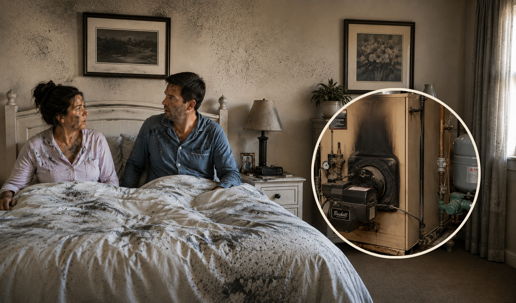
A homeowner experienced a puffback in the middle of the night while everyone in the house was sleeping. Nobody knew it had happened.
They found out the next morning.
Black, oily soot had spread throughout the house. It covered the walls, ceilings, furniture and belongings.
Even the people sleeping in the home woke up with soot on them.
Imagine going to bed in a perfectly normal house and waking up to find yourself and your home covered in black soot.
How Does Soot Get Through the Whole House?
If you have an oil-fired forced-air furnace and central air conditioning, the two systems may share the same blower and ductwork.
Normally, those ducts distribute heated or cooled air throughout your home. But if soot from a puffback gets into the system, that same ductwork can potentially carry it into rooms throughout the house.
The soot can settle on walls, ceilings, carpeting, furniture, window treatments and personal belongings.
What started as a problem at the furnace can quickly become a whole-house cleanup.
And That Cleanup Can Be Expensive
Puffback soot isn’t ordinary household dust. It’s an oily residue that can be difficult to remove and may leave behind a strong odor.
Depending on how far it spreads, professional cleanup may involve walls and ceilings, floors and carpeting, furniture and personal belongings, as well as contaminated HVAC components and ductwork.
Significant puffback cleanup can cost as much as approximately $13,000. More extensive losses involving widespread contamination, damaged belongings or repairs can cost even more.
Homeowners insurance may cover sudden and accidental puffback damage, depending on the circumstances and your individual policy.
But wouldn’t you rather avoid the whole mess?
Why You Shouldn’t Try to Clean Up a Puffback Yourself
When you see black soot covering your walls, your first instinct may be to grab a bucket and start cleaning.
Don’t.
Soot contains very small particles, some of which can become airborne and be inhaled deep into the lungs. Exposure to fine particles can irritate the eyes, nose and throat, cause coughing or difficulty breathing and aggravate respiratory conditions such as asthma. Children, older adults and people with existing heart or lung conditions can be particularly susceptible.
Trying to clean puffback soot yourself can also make the damage worse.
Using water or ordinary household cleaners on soot-covered surfaces can push the oily residue deeper into walls, ceilings, fabrics and other porous materials, making stains and odors even more difficult to remove. Scrubbing, wiping or improperly vacuuming contaminated surfaces can also spread the soot or send particles back into the air.
And what you see may only be part of the problem.
A significant puffback can contaminate carpeting, upholstered furniture, clothing and other belongings, along with the heating system and ductwork. Wiping the soot off the walls doesn’t necessarily remove contamination elsewhere in the house.
Professional restoration technicians use appropriate protective equipment and specialized cleaning methods for different surfaces and contents while taking steps to prevent the soot from spreading further.
If you experience a significant puffback, resist the urge to start scrubbing. Contact your insurance company and a professional property damage restoration company before you begin cleaning.
If You’ve Never Had Your Heating System Serviced, Make This the Year
ENERGY STAR recommends having heating equipment professionally checked every year.
If you’ve never scheduled annual maintenance because your furnace or boiler has always worked, that’s understandable. When something works year after year, it’s easy to assume there’s nothing wrong with it.
But a heating system doesn’t have to stop working completely to have a problem.
A dirty burner nozzle, deteriorating ignition components or improper combustion may be developing long before you find yourself without heat. An annual inspection gives a professional the opportunity to find and correct those problems.
And when you consider what a puffback can do to a home, the cost of an annual service call starts to look a little different.
It’s Still Summer. Make the Appointment Anyway.
Nobody is suggesting you turn on the heat in August.
But if you rely on oil heat, especially if you’ve never had your furnace or boiler professionally serviced, this is a good time to start.
Annual maintenance can't guarantee that you'll never experience a puffback. But it can identify and correct some of the problems that can contribute to one.
Because the fact that your heat came on perfectly well last winter doesn’t necessarily mean everything inside your heating system is working the way it should.
And finding out during an annual service call is a whole lot better than finding out when oily black soot is covering your house.
If a furnace or boiler puffback causes damage to your home, Single Source Disaster Recovery provides 24/7 emergency property damage cleanup and repair throughout Rhode Island.